Nazanin Bahrami
Omid Mashhadi
You Have Seen This Before
Artwork presented as part of the Entropy exhibition at Künstlerhaus Bethanien, Berlin (16 Oct 2025–14 Dec 2025).
Installation
300x150 cm
2025
by Nazanin Bahrami
You Have Seen This Before, news snippets are printed on long rolls of transparent paper, reminiscent of film strips. With each repetition, images fade and blur, until they dissolve altogether. The work probes the constant effort needed to stay present amid editorial bias, censorship, and algorithms that dull empathy and normalize detachment.

Photo: Franziska Taffelt
“I go to war because I think it’s my duty to be in as much contact with reality as I can be. It is certainly a duty to bear witness in writing and in other forms, to what is going on here.”
Susan Sontag, in her interview with Bill Moyers (PBS), broadcast on April 4, 2003, reflecting on Sarajevo (1993–95)
I’m interested in how, in our current reality, the labor of stay connected and feel the present turns into an experience of entropy. To grasp what is happening to us, we have to train ourselves and work against the news cycle, people’s judgments, social-political incentives, and the strain on our mental balance. But this this the const we have to pay when we want to be or become human?
How newsworthy is witnessing others’ suffering? How do we bear witness to that suffering? How do the Other’s pain and grief resonate with our own? How can we connect with distant pain and death across wide geographical and cultural gaps? Could the silencing and distortion of reality through biased news coverage be one of humanity’s deepest injustices? How do we protect ourselves from a normalized, hidden, manipulative news machine? How do we protect our humanity in a world that creates “others,” categorizes, archives, and ranks people?
When editorial biases, state censorship, or opaque recommender systems foreground certain lives and sideline others, collective empathy slowly wears down. Hannah Arendt described this as the “banality of evil”: routine processes that erode moral judgment without spectacle. The harm lies in procedures that normalize selective blindness.
In this project, I am questioning how news algorithms assemble streams of images and how this assembly shapes our capacity to care. I build on Paul Slovic’s idea of “compassion fade”: as images repeat and numbers rise, attention slips, violence becomes background, and detachment grows. I approach this through the lens of entropy the drift toward disorder and the scattering of information. In media streams, entropy appears as repetition without memory, rising noise, and lost context. Each act of attention requires work; creating a clear signal is local and must be renewed.
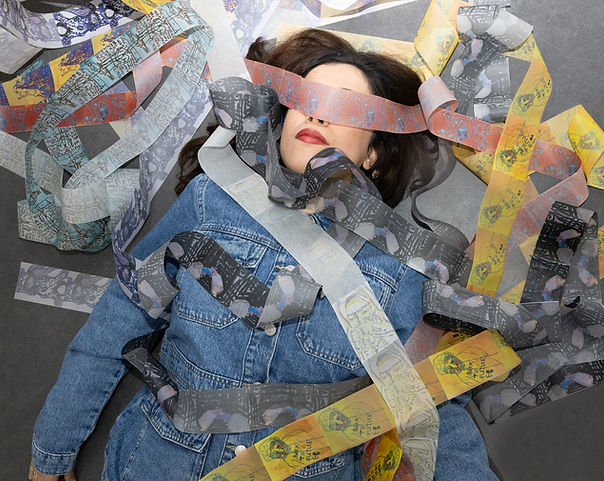
Photo: Franziska Taffelt

Photo: Franziska Taffelt